Basketball League Schedules: Why AI Can't Generate Them

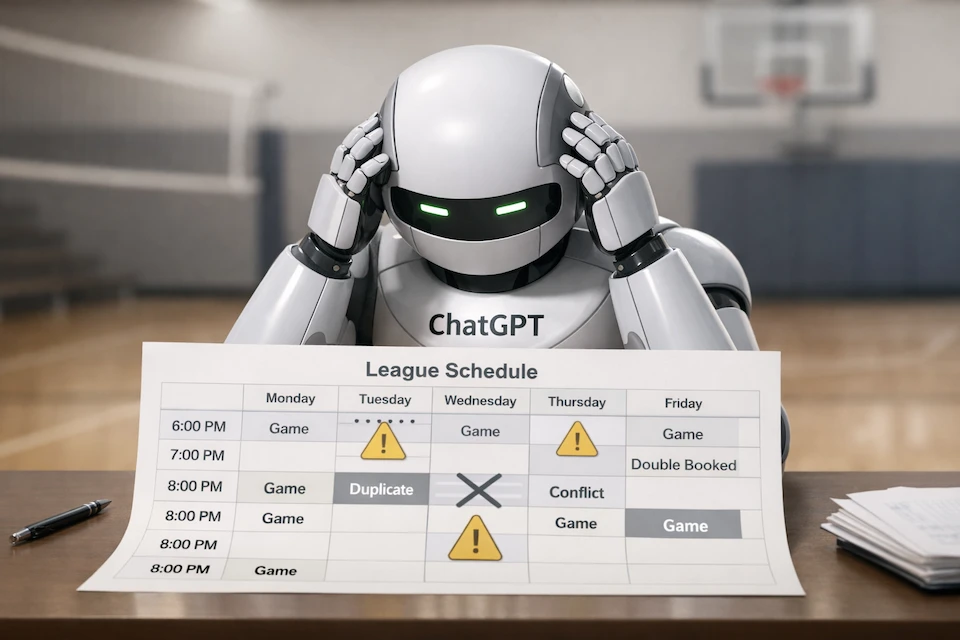
Scheduling a basketball league might look easy on paper, but anyone who has tried it knows it quickly gets complicated. Teams have different availability, venues have limited time slots, and organizers need fair matchups. With so many moving parts, it's no wonder that general AI tools like ChatGPT can't handle the full picture. Specialized scheduling software exists to handle these challenges.
TL;DR
- AI platforms, like ChatGPT, Gemini, and Claude are great at generating text but they are not built to solve complex constraint problems.
- Creating a fair basketball league schedule requires balancing time slots, byes, matchups, and special requests all at once, which AI platforms are not built for.
- League managers need a dedicated basketball league schedule generator, like hoops.love, to produce truly fair and balanced schedules.
Why is creating a league schedule so hard?
In order to keep a schedule fair and balanced, there are many things to keep in mind as you build it. All good league schedules try to ensure:
- No team ever plays in two places at the same time.
- Teams should play everyone once before they play anyone else again.
- When teams do play each other again, there should be a reasonable time gap before the rematch.
- Teams should all play an equal number of times in each time slot as the season progresses. Nobody wants to play at 9pm all the time.
- Sometimes double-headers are required. When they are, they need to be distributed evenly amongst your teams.
- No team should ever have to sit between double-header games. They should be scheduled back-to-back.
- Bye weeks need to be evenly distributed amongst teams.
- Bye weeks should also be properly spaced out throughout the league.
- All teams should play an equal number of games, or as close to equal as possible.
How do special requests make league scheduling harder?
Adding special requests when you're building a league makes it exponentially more complicated because there are so many things to consider. This challenge isn't unique. There's a term for it, called a constraint satisfaction problem (CSP). According to mathematicians, CSPs are really hard to solve, and many of these scheduling variants are NP-hard. In fact, even our modern computers have a very, very hard time building league schedules primarily because of just how many options there can be. So, don't feel bad when you struggle making schedules by hand. It's mathematically proven to be a hard thing to do!
Here are some examples of special requests that might be asked for in a basketball league schedule:
- Team 1 can only play at 6pm
- Team 2 can play at any time except 6pm
- Team 3 and 4 carpool and need to be scheduled for the same time, or at least neighboring times
- Team 5 cannot play the fourth week of the league and must have a bye
- We have teams reffing, so we want to make sure they also don't sit between reffing and playing
An Example of Why Creating a Basketball League Schedule Is So Complex
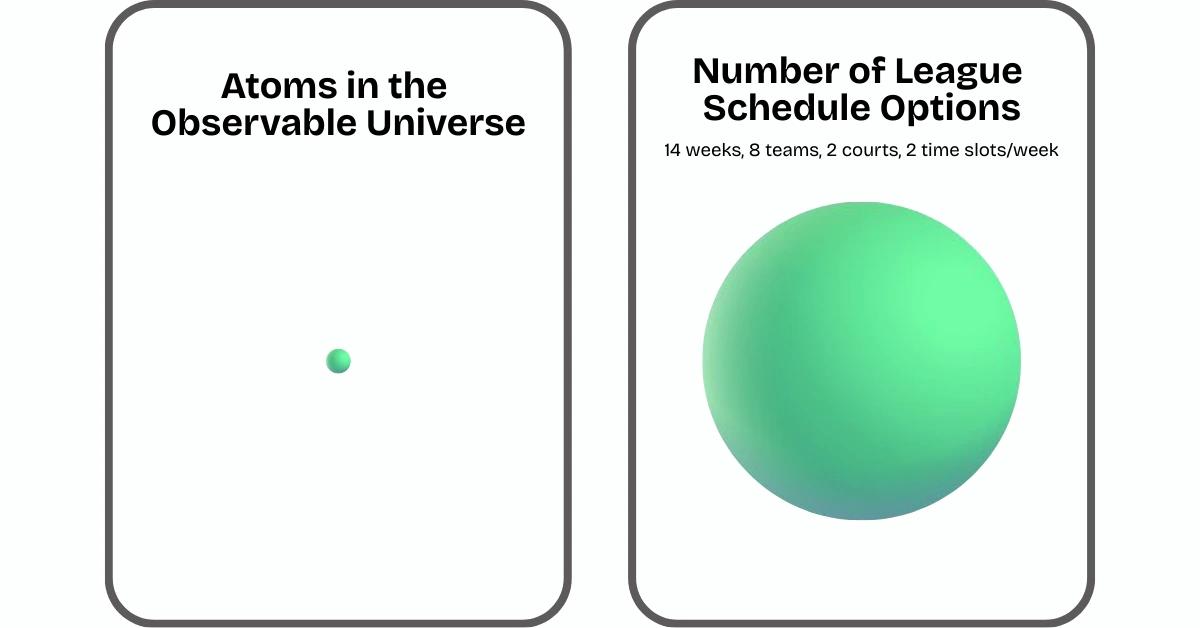
Let's use a small, simple league schedule to illustrate how drastically things get out of hand. In this scenario, we have: 8 teams, 2 courts, 2 time slots (6pm and 7pm), and the league runs for 14 weeks.
| 6:00 PM | 7:00 PM | |||
|---|---|---|---|---|
| Court 1 | Court 2 | Court 1 | Court 2 | |
| Week 1 | Game 1 | Game 2 | Game 3 | Game 4 |
| Week 2 | Game 5 | Game 6 | Game 7 | Game 8 |
| Week 3 | Game 9 | Game 10 | Game 11 | Game 12 |
| ... | ... | ... | ... | ... |
| Week 14 | Game 53 | Game 54 | Game 55 | Game 56 |
In this schedule, there will be 56 total games that we have to fill in and every game has 28 matchup options. This means that:
- Game 1 has 28 matchup options
- Game 2 has 28 matchup options
- Game 3 has 28 matchup options
- Game 4 has 28 matchup options
- Every week, every game has 28 matchup options
Even in this simple example, there are actually 28^56 possible schedules that could be created. That's 28 multiplied by itself 56 times. After completing that calculation, the total number of possible schedules is actually larger than the estimated number of atoms in the observable universe. 🤯
Why ChatGPT Cannot Create A Fair Basketball League Schedule
ChatGPT is the wrong tool for the job because it's a prediction engine that generates text based on patterns. It doesn't actually solve problems.
What that means is, it makes schedules that look right but doesn't actually check all your constraints. It can't verify that teams are distributed fairly across time slots, or that double-headers are spaced properly, or that the schedule is actually balanced. It produces a nice table with all your games filled in. The more you look, the more issues you will find. Problems like:
- Team 1 plays at 6pm six weeks in a row.
- Team 2 is stuck at 7pm every week.
- Week 8 has Team 3 scheduled for a double-header but there's no space for it, so now Team 7 randomly has a bye.
Fundamentally, if ChatGPT is the wrong tool for the job, what's the right tool?
The Right Tool for Basketball League Scheduling
Computer algorithms made to solve league scheduling challenges are known as "Solvers". Solvers work in a completely different way than modern AI, like ChatGPT, Claude, and Gemini. Solvers use smart decision making to search through the universe of possible options and find a "good enough" solution without looking at every possible solution.
With our simple example resulting in 28^56 possible schedules, with no special accommodations. Adding in just one accommodation request ("Team 3 can't play at 6pm") and suddenly you need to search through billions of valid schedules to find one that's still fair and balanced. Even the fastest computers in the world can't test every possible schedule. The numbers are simply too large.
How Do League Managers Find The Best League Scheduling Tools?
Providers like hoops.love are experts in creating specialized scheduling algorithms (not AI prediction engines) that understand how basketball leagues should be structured. Their scheduling platforms are built specifically to solve this problem and search smartly through the possibilities to find schedules that meet all your constraints for your unique situation.
The best scheduling tools make it easy for league managers to leave spreadsheets and AI results behind. Simply give them your league setup and any team accommodation requests (like "Team 3 can't play at 6pm"), and they should be able to generate a fair, balanced schedule that actually works in minutes. No teams playing twice at once. No unfair time slot distributions. No hidden conflicts.
They may also offer things like:
- Schedule hosting, so teams can easily access game times online
- Self-reporting, so players report their own scores
- Real-time team standings updates
If you're evaluating options, it helps to compare each platform's league setup and scheduling workflow and pricing model.
Takeaways
- Basketball league scheduling is complex, with billions of possible combinations once you factor in time slots, byes, double-headers, and special requests.
- General AI tools like ChatGPT can generate schedules that look correct but cannot ensure fairness or meet all constraints.
- Dedicated scheduling algorithms, like those used by hoops.love, efficiently navigate all possibilities to produce fair and balanced league schedules.
- Specialized platforms make it easy for league managers to accommodate team requests, prevent conflicts, and provide features like online score reporting and real-time standings.
Take the stress out of scheduling your basketball leagues. With hoops.love, you can generate fair and balanced schedules that handle all constraints in minutes and review them with no payment required until your league starts.
Last updated: March 10, 2026